

Levels of Practice
The framework focuses on levels of practice and is not described by role titles or agenda for change bandings. The levels of practice are broken down into 7 groups:
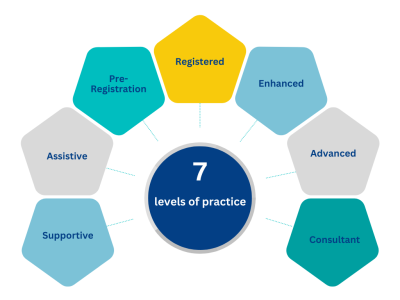
- Supportive
- Assistive
- Pre-Registration
- Registration
- Enhanced
- Advanced
- Consultant
Examples of job roles at supportive level:
- Cancer Support Worker
- Cancer Navigator
- Cancer Care Co-ordinator
- Healthcare Assistant
- Therapy Assistant
- Allied Health Support Worker
- Cancer Navigator
- Healthcare Support Worker
- Solid Understanding: Possesses a solid understanding of facts, principles, processes, and general concepts.
- Engagement: Engages in a wide range of duties with some responsibility, under guidance and supervision as needed.
- Commitment: Committed to delivering high-quality, compassionate healthcare.
- Informed Decision-Making: Uses knowledge to make informed decisions, takes ownership of work, and actively reviews its effectiveness.
- Adherence to Standards: Adheres to standards, policies, and protocols within the bounds of their expertise.
Useful resources:
NHS Learning Hub:
https://
The Principles of Cancer Care:
https://
Free Cancer Webinars:
https://
NHSE Supportive and Assistive Toolkit:
ACCEND: Supportive and Assistive level of practice - elearning for healthcare
Examples of job roles at assistive level include:
- Nursing Associate (England only)
- Assistant Practitioner
- Registered Pharmacist Technician
A foundation of factual and theoretical knowledge is essential for individuals working in assistive level roles.
Key attributes include:
- Independent and Collaborative Practice:
- Operates both independently and collaboratively under the guidance of a registered nurse or Allied Health Professional (AHP).
- Adheres to agreed care plans and protocols.
- Versatile Skill Set:
- Caters to local health populations, considering the unique perspectives of individuals, families, and carers.
- Holistic and Personalized Care:
- Provides comprehensive care, supporting the entire care process while following standard operating procedures and protocols.
- Service Development:
- Actively contributes to service development by making judgments, planning activities, and committing to self-development.
- Enhancing Patient Care:
- Plays a crucial role in improving the overall quality of patient care within cancer services.
Useful resources:
NHS Learning Hub:
https://
NHSE Supportive and Assistive Toolkit
ACCEND: Supportive and Assistive level of practice - elearning for healthcare
The pre-registration workforce consists of individuals undergoing training and education to become qualified healthcare professionals. They are in the process of completing their educational and practical training through university programs and clinical placements.
Examples of Job Roles:
- Pre-registration nursing students
- Allied Health Professional (AHP) students
- Pharmacy students/learners
- Trainee Nursing Associates
These individuals are undertaking pre-registration foundation, undergraduate, and postgraduate degree courses leading to registration with the HCPC, GPhC, or NMC.
Useful resources:
NHS Learning Hub:
https://
Examples of Job Roles:
- Registered Nurse (all fields)
- Registered Allied Health Professional (AHP)
- Registered Pharmacist
These professionals are at the point of registration and during preceptorship.
These healthcare professionals have completed their education and training, accredited by a recognised body. They are qualified and licensed to practice within the scope of their specific profession.
Other Attributes Include:
- Competent in their field of practice
- Adhere to professional standards and protocols
- Continuously engage in professional development
- Provide high-quality care and services
Examples of Job Roles:
- Registered Nurse (all fields)
- Registered Allied Health Professional (AHP)
- Registered Pharmacist
Experienced practitioners who require in-depth role-specific cancer knowledge and skills or training. These professionals go beyond the basics, acquiring additional skills, knowledge, and experience beyond their initial registration requirements. They often take on more specialised roles with increased responsibilities.
Other Attributes Include:
- Advanced expertise in their field
- Proactively engage in continuous learning
- Provide mentorship and guidance to less experienced colleagues
- Lead or participate in specialized projects and initiatives
- Adapt to evolving practices and technologies in cancer care
Examples of Job Roles:
- Registered Nurse (all fields)
- Registered Allied Health Professional (AHP)
- Registered Pharmacist practicing as an Advanced Practitioner (AP)
Advanced practitioners are professionals who have pursued further education, training, and often certification. They have an expanded scope of practice, allowing them to take on more complex clinical tasks.
Other Characteristics Include:
- In-depth Knowledge and Leadership:
- Possesses a critical understanding of detailed theoretical and practical knowledge, either as generalists with a special interest or specialists with focused expertise.
- Manages and leads responsibilities within their role effectively.
- Advanced Clinical Skills:
- Combines advanced clinical skills with research, education, and clinical leadership seamlessly within their scope of practice.
This level not only represents a culmination of advanced skills but also a commitment to holistic, innovative, and impactful practice within the ever-evolving healthcare landscape.
At this level, practitioners not only represent the pinnacle of clinical expertise but also epitomize leadership, innovation, and a commitment to shaping the future of healthcare on a broad scale.
Examples of Job Roles:
- Registered Nurse (all fields)
- Registered Allied Health Professional (AHP)
- Registered Pharmacist practicing as a Consultant Practitioner
What sets them apart?
This is the highest level of practice and involves professionals who have achieved a significant level of expertise in their specialty. Consultants are recognized leaders in their field and may be involved in teaching, research, and leading clinical teams.
Other Attributes Include:
- Extensive clinical expertise
- Leadership and innovation
- Commitment to advancing healthcare
- Engaging in teaching and research
- Leading clinical teams and initiatives
Capabilities in Practice (CiP’s)
CiP's refers to the attributes (skills, knowledge, and behaviours) that individuals bring to the workplace. These capabilities are divided into seven different domains within the framework and are broken down for each pillar of practice:
• Clinical
• Management and Leadership
• Research
• Education
These pillars represent the core professional activities and are essential for your continuous development. The number of CiP’s you are expected to meet within each domain depends on your level of practice. As you advance in your career, the expectations and requirements will evolve accordingly. It is crucial to be aware of these domains and understand how they relate to your current and future roles.
- Domain A: Person - centred collaborative working
- Domain B: Assessment, investigations and diagnosis
- Domain C: Condition management, treatment and planning
- Domain D: Leadership and collaborative practice
- Domain E: Developing evidence based practice
- Domain F: Quality Improvement
- Domain G: Educating and developing self and others