

Discover how the Psychosocial Support Toolkit can help you support people affected by cancer: This video explains what it offers and how to make the most of its resources.
Make it easy to share and promote the Psychosocial Support Toolkit with your team: this printable pack gives managers everything they need: FAQs, key information, posters, presentation slides, newsletter content, and social media posts, so they can copy, paste, print and start sharing now.
Purpose
The Cheshire and Merseyside Psychosocial Toolkit has been developed collaboratively with clinicians, specialist services, and individuals affected by cancer.
It aims to promote existing psychosocial support services and referral pathways, while providing a practical and accessible resource for professionals across Cheshire and Merseyside. This ensures that individuals affected by cancer are able to access the right support, at the right time.
Why this toolkit matters
Cancer touches thousands of lives across Cheshire and Merseyside.
With over 17,000 new cases each year and survival rates rising, more than 111,000 people are living with and beyond cancer.
However, the psychological and social impact continues to be significant, particularly in more deprived areas where access to support can be limited.
| Cheshire and Merseyside Cancer Alliance Data | |
|---|---|
| 111,000 | Number of people living with cancer |
| 23% | Living in the most deprived quintile1 (IMD1) (2019) |
| 56.0% | People diagnosed with cancer that survive for five years or more (2016-2020) |
| 46.8% | People diagnosed with cancer that survive for ten years or more (2011-2020) |
Toolkit structure and features
The toolkit is structured into two complementary resources, reflecting the breadth of psychosocial support needs across the cancer pathway.
Psychological Support Needs
This resource focuses on psychological wellbeing and includes guidance and support relating to:
- Mental health support
- Emotional support
- Identity
- Safety
- Trauma
- Relationships
Social Support Needs
This resource addresses wider social and practical factors that impact on wellbeing, including:
- Financial support
- Activities of daily living
- Community connection and social inclusion
- Spirituality
- Health inequalities and access to support
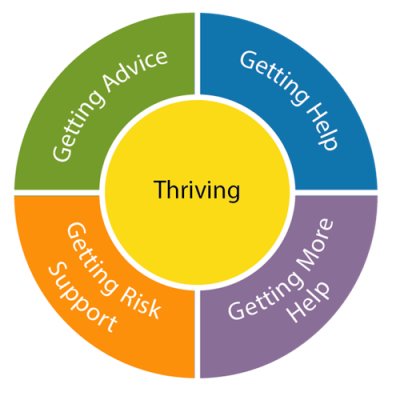
The Thrive Framework
The THRIVE Framework offers a structured, person-centred approach to mental health and wellbeing, adapted to support adults living with and beyond cancer.
This Includes:
Thriving: Building resilience through community resources and education
Getting Advice: Accessible information and signposting
Getting Help: Psychological interventions like counselling or guided self-help
Getting More Help: Specialist therapies (e.g., CBT, clinical psychology)
Getting Risk Support: Managing complex needs
This needs-led model ensures individuals receive the right level of support for their situation.
Levels of Support Model
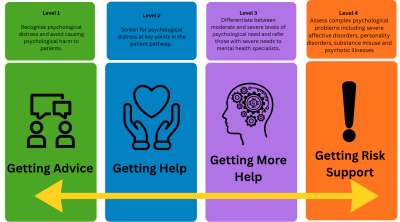
The Level of Support Model complements THRIVE by offering a tiered approach that adjusts the intensity of support according to individual need.
Each level of support includes:
-
Level 1: Getting Advice – information provision, peer groups, and self-management tools.
-
Level 2: Getting Help – brief interventions, such as guided self-help or telephone-based support.
-
Level 3: Getting More Help – structured psychological therapies or specialist mental health support.
-
Level 4: Getting Risk Support – specialist mental health support for safety needs.
References
1) Index of Multiple Deprivation (IMD) decile 1 (1= Most deprived) indicates the most deprived area on England. health and housing. English indices of deprivation 2025: frequently asked questions - GOV.UK
Your feedback is important to us and helps us ensure that this resource is supporting you and the people you are working with. Please let us know if you have encountered any issues while using the Psychosocial Support Toolkit by contacting us on the email below:
ccf-tr.admin.cmca@nhs.net